Monday, May 14, 2007

Day 186 May 14th 2007, Tofu again - Koyasan to Hiroshima


After getting up at 6AM and then having cold tofu for breakfast living with monks may not be the cup of tea I thought it was. I can handle cold tofu for dinner but not for breakfast. The morning prayers were very interesting and after seeing the fire ceremony I can see how many of the temples have to be rebuilt on a regular basis.

Before setting off for our next destination we managed to squeeze in one more visit to a temple, Kongobui, the headquarters of Shingon-shu Buddhism. The temple boasts the largest rock garden in Japan. The garden represent a pair of dragons emerging from the clouds.


From dragons to trains we took the Shinkansen to Hiroshima. I'm not really that interested in trains but these things are impressive, the one pictured below was pulling into the station while we waited for ours. Our ride to Hiroshima was on a 700 Series call me a trainspotter but these things go at 270km/h incredible.


Thinking damn we are so far behind back in the UK, I was wrong the Eurostar is actually capable of reaching 300km/h. I guess the difference is the Japanese can actually get it working consistently and on time all of the time throughout the entire country. But wait just one more train fact China has a train system that runs at 430km/h. uh oh I'm scaring myself now - no more train talk.

Highlights: Tofu must be good for you if it tastes that bad
Day 185 May 13th 2007, Tranquility - Osaka to Koyasan

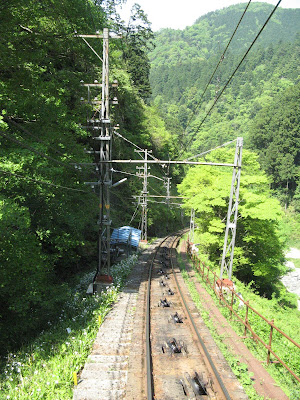
In sure that being sent to stay with the monks was one of the threats used by my parents when I was young to get me to behave myself. Well after arriving in Koyasan I can say it probably wouldn't have been that bad. The journey to the mountain home of Shingon Buddhism is an interesting one, about 2 hours by train south from Osaka, a cable car type train up the mountain and then a short bus ride round the mountain to the small town.

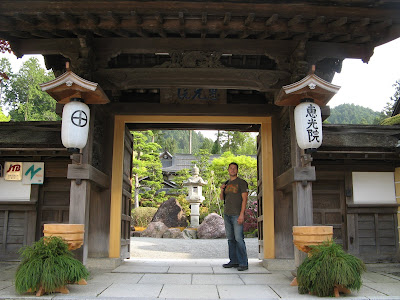
Above: View from the back of the train as we climbed towards the top of the mountain. Below: the Koi pond at the center of the Eiko-in temple were we were staying. Me outside the entrance to the temple and the third photo is of one of the temple buildings.


The temple had a very relaxing atmosphere and the monks were very friendly and welcoming. Despite my protest that my rucksack was heavy and that I should carry it to our room the monk refused, on picking it up he laughed saying "not heavy for me" I guess it must be all the Tofu. Dinner was served in our traditional Japanese room, I know it was Tofu made to a 1,100 year old recipe but that's about all I can tell you. Quite an interesting meal. After dinner the monks laid out our futons, the hard floor would apparently be good for our backs. Not quite sure yet what to make of the rice filled pillows.

Highlights: Tranquility at Eko-in
Day 184 May 12th 2007, Whales and Octopus - Osaka


I think I may have said this before, if I haven't I'm sure I will again, Japan is a land of contrast. From historic Nara to modern Osaka in about an hour, its like being transported through time. I don't think that we saw a single temple or shrine today but I'm sure they were around. Instead we visited the Osaka aquarium, I had to see for myself that they had a Whale Shark, the largest living fish, here.


There are some great displays here including the Sea Otters above but the Whale Shark and Manta Ray tank (for want of a better expression) is astonishing. In the top photo below you can see the Whale Shark and below tow divers cleaning the tank. Amazed that they have something this size in captivity I was surprised to find out that they have a two Whale Sharks at the Okinawa aquarium. The tank used to house the shark contains 5,400 cubic meter of water. In all the aquarium tanks are built from 314 tonnes of Acrylic, that's 1.5 times the annual world production of this material.


I'm never 100% sure about these places, on one hand it gives people a great educational opportunity which should hopefully lead to the conservation of such creatures. On the other hand it just doesn't seem right to have a creature that would roam the seas in an aquarium.


Above Shelley on the other side of the giant grabs aquarium, this isn't a trick of the camera that crab really covers the side of the tank. Below Samurai Shelley.

After taking a ride on the Worlds biggest or one of the biggest ferris wheels in the World, depending on which leaflet you read, we set of for the Dotonbori area of town.


Following a recommendation (hhhmmmmmm set up) we triedTakoyaki, which are balls of fried Octopus, I actually quite liked them but Shelley wasn't so sure. Amongst the Neon lights of Dotonbori there are plenty of karaoke bars, after a few beers to wash down the octopus we found ourselves in one, yes I did take a video and no I wont be letting anyone see it.


Highlights: Night out in Dotonbori
Day 183 May 11th 2007, Japans Largest Buddha - Nara

In a complete contrast to yesterday the sun was shining with not a cloud in the sky as we headed towards the historic side of Nara. The city is a treasure trove of Ancient Japan with 8 designated World heritage sites. Nara park is home to some 1,200 wild silka deer, these deer have free roam of the city and are classed as a national treasure. They behave like they own the place. OK feeding wild animals usually makes them aggressive so what did I expect when I brought some "special deer rice cakes" to feed them, I certainly didn't expect them to try and eat our map.


Along side the deer there also appeared to be every school kid in Japan visiting the park, all very keen to know if we spoke English, what our names were and where we were from, before asking us to sign their book.
w is part of Kofukuji temple.


One of the big sites in Nara is the largest Buddha in Japan, housed in the Todai-ji temple, the south gate in the photos below is another national treasure, a lot better behaved than the deer variety. This is apparently the largest wooden building in the world but I have heard that at least once before at other temples in Japan.


Inside the gates are two great Nio guardians, according to Japanese tradition two of these guardians travel with Buddha to protect him. The wood work is incredible, from the photo and from a distance they look like a painting but they are actually solid wood figures.


Below is the entrance to Todai-ji some 2.6 million people were involved in the construction of the temple and its giant Buddha. Started in 743 and completed in 751 it sounds like there were some project managers over specifying the man power requirements.


Inside the temple is the largest Buddha in Japan weighing in at 500 metric tonnes with a height of 14.98 meters. Check out the guy on front of the Buddha to get a better idea of the scale.


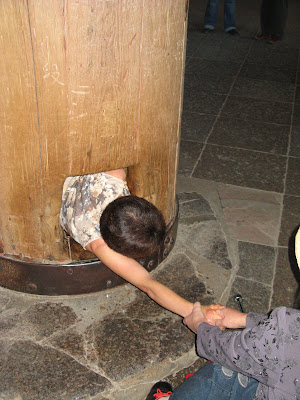
One of the supporting posts in the Great Buddha Hall has a hole that has been cut through the base. Visitors try to pass through the hole which is said to be the same size as one of the Buddhas nostrils. legend has it that those who pass through it will be blessed with enlightenment in their next life.

Children usually have no trouble getting through but adults sometimes get stuck and need to be pulled out. Despite all the rice and raw fish I have been eating lately I thought better of it and left it to the kids, after all I didn't want to be stuck here with an endless procession of school kids asking if I spoke English, what my name was and where I was from ;-)
Close to Todai-ji are the stunning Isuien Gardens pictured below.

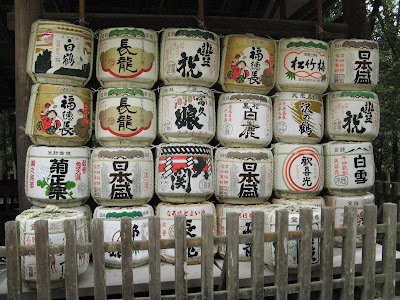
On the far Eastern side of Nara Park is the Kasuga Taisha Shrine, one of the 8 World Heritage sites. Originally built in the 8th century the shrine was taken apart and rebuilt every 20 years in accordance with Shinto tradition until the end of the 19th century. In the photos below you can see the entrance, followed by a collection of Sake barrels left as an offering at the shrine. In the last picture is another one of the gates to the shrine. Have you seen enough photos of temples and shrines yet ?



Highlights: Nara Park and everything in it
Day 182 May 10th 2007, Fast Food and Fast Cash - Kyoto to Nara


The guide book says to make sure you visit Nara on a sunny day, as we gazed out of our hotel room window through the pouring rain across the city's rooftops we couldn't agree more. On days like this the trusted rainy day plan is brought into play

1. Starbucks - today in the form of an English tea room scones an all
2. Fast food - Moss Burger (luckily not made form moss)
3. Cinema - Spiderman 3

Theres always a bit of uncertainty going to a cinema abroad, you never really know if the films going to be in English. In Japan we have found that you need to be very careful in how you ask a question to ensure you get the right answer.

For example asking "Is Spiderman in English?" could be interpreted as "Is Spiderman English" so refining this "Does Spiderman speak English?" the answer would be "Yes" but not necessarily in this film. The correct question to ascertain if a film is in English is to ask "Does this film have Japanese subtitles?", you then find yourself in a French film. Luckily old spidey was in English.

Finding a cash machine in Japan that accepts international cards is no easy task so here's a couple of tips to make sure whilst in Japan you are flush with cash.

1. Find a post office they all seem to have international cash machines (a fact the guidebooks don't seem to mention)

2. Do not try and take out 500,000 Yen (about 2,000 UK) as this will probably cause your cash card to be blocked. An easy mistake to make when the cash machine instructions are in English.

Highlights: Spiderman, Spiderman does whatever a spider can
Day 181 May 9th 2007, Nintendo - Kyoto

No up, no down, no Insurance read the add for the Johnny Hill walker guided tour of Kyoto. Its quite a short walk about 2km but takes nearly 5 hours winding through the backstreets of Kyoto, taking in Buddhist temples, Shinto shrines and the ancient cottage industries of the city which includes Nin-ten-do??


The tours first stop is at the Higashi Hongashi temple, unfortunately much of the site was under restoration. The temple was until recently sinking under the weight of its roof tiles, these are now being replaced lighter ones, problem, fixed. There was still plenty to see including the magnificent Dragon Fountain in the photo above next to Johnny Hill walker. Surprisingly in one of the newer temple building there was a state of the art cinema where even more surprisingly the monks sometimes watch Rock Music Videos. I'm not sure if this was a joke or not but the monks we have met seem a jolly laid back bunch of guys.


Above is the entrance to Higashi Hongashi, behind it you can see the building which has been built around the temple to protect it whilst its being restored. I was standing about 50m from the gate when I took this photo so you can get an idea of how big these temples are.

Amongst the fan makers and potters there is the original Nintendo building, here is where it all started in the form of a card game called Hanafuda in 1889, right here in the back streets of Kyoto. Before coming the video game giant they are today Nintendo ran a taxi company and a love hotel. Quite something as Nintendo now turns over US$4.5 Billion a year.


The last stop of the day was at yet another temple Kiyomizu-Dera. Visually impressive and like Machu Picchu in Peru nominated for one of the new 7 wonders of the world. The main temple is built upon wooden stilts, with a 39ft drop from the veranda. It is said that if you can survive a jump from here you wish will be granted. There were 284 jumps before it was prohibited and 84% of jumpers survived.


Weary from a long days walking we headed back to our hotel through one of the charming side streets near the temple.

Highlights: Pretty interesting to learn the history of Nintendo and the temples were stunning again today

Wednesday, May 09, 2007

Day 180 May 8th 2007, Japanese River Rapids - Kyoto

The Japanese seem to do everything a little differently and this extends to white water rafting. Here on the Hozu River you go down through the rapids in a wooden boat. Now the rapids were a little tame but still interesting enough in a wooden boat. On route we caught site of some of the wild monkeys they have in this region of Japan. They have been know to get a bit rough with hikers and you are advised not to try and stare them out.


Above: Our skipper was full of jokes, none of which we could understand

Above: Towards the end of the cruise we moored up alongside some sort of food boat Below: A nice order of chewy octopus

Continuing on from the boat trip down river, a walk through a bamboo forest before catching the sightseeing train back towards Kyoto.

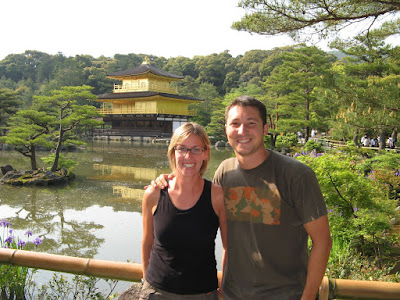
On arriving back in Kyoto we visited whats know as the Golden Temple (Kinkaku-ji) no prizes for guessing where it got its name from. It was built in 1397 and as with many of the temples we have visited in Japan burnt down and rebuilt several times. The most recent in 1950, rebuilt 1955. It was Kinkaku-ji that was the inspiration for Ginkaku-ji or the Silver Temple that we visited a couple of days ago.
Nothing like a cup of tea in the afternoon

Highlights: Gold leaf at the Golden Temple
Day 179 May 7th 2007, Memoirs of a Geisha - Kyoto

Another day another walk, this time around some of the many temples and shrines in Kyoto. I had told Shelley it would be ok to wear sandals today. I overlooked the 2 hour hill walk with a steep descent from 650m that was part of the trail. I have lost my job as tour planner.

We started off by visiting Ginkaku-ji temple which was built in 1474, it was originally supposed to be covered in silver but as you can see from the photo below is impressive enough as it is.

Eventually we arrived at the rather large Nanzen-ji temple. The architecture of the temple is impressive but the gates are something else. In the photo below you can see the gate which was built in 1628 towering above the trees.

Close to Nanzen-ji is Tetsugaku-no-michi or the path of philosophy. Its a beautiful tree lined canal with the occasional carp making its way down stream. After not paying attention to where I was walking I nearly went for a swim, decided it would be a good idea at this point to stop for an ice cream. There was a choice of flavors such as Vanilla, Cherry Blossom, Green Tea or Brown tea. You could also have some nice cold green tea as shown in the photo below.

Hmmm not sure about this one

Japanese Architecture in Gion one of the Geisha districts
Geisha are another example of traditional Japan. In Kyoto where the tradition is strongest there are only about 150 Geishas today from 80,000 in the 1920s. The best time to see them is about 6PM as they hurry to work.
Geisha facts:
  • A Geisha is a traditional Japanese entertainer, skilled in Music, dancing and singing
  • Many are highly educated holding University degrees
  • A Geisha's time with a client is measured by the burning of an incense stick
  • Not just anyone can enjoy the company of a Geisha, you have to be pretty well connected with someone in the know and also your bank manager
  • Geisha's are not allowed to marry
  • They are not prostitutes as many in the West believe
  • It will cost you over US$1,000 for an hour of a Geisha's company

Highlights: Ginkaku-ji temple and catching a glimpse of some real Geisha

Monday, May 07, 2007

Day 178 May 6th 2007, A Rainy Day - Kyoto

The rain was coming down today in Kyoto so after visiting tourist information we took a quick look at a Koi pond, which was at one of the city's 2000 temples, then took refuge in an Internet cafe for the afternoon.

Being Japan this is no ordinary Internet cafe, you can choose from a business booth, a reclining booth, a booth with a sofa or one with a bed. In addition you can use the Tanning bed to top up on your tan if you haven't seen the light of day for some time.


Some facts about Kyoto:
  • Original capital of Japan - The Imperial family lived here from 794 to 1868 when the emperor relocated to Tokyo
  • Kyoto and Nara were not bombed during WWII - Due to their cultural significance they were spared from any bombardment
  • 38 Million tourists visit Kyoto each year
  • On December 11th 2007 the Kyoto Protocol an amendment to the UN Framework on climate change was opened for signature in Kyoto
Highlights: Not having to go on a train today (ok except for the underground)